History of the Boat.
‘Ar Bageergan’, the name means ‘the eye of the wind’, was built as a Breton ’tunny’ boat in Le Guilvenic, SW Brittany in 1973. She worked as a tuna boat and also as a crabber during the off season. She was retired from fishing in France after ten years and sold to a Newlyn fisherman in Cornwall. He worked her until 2000 as a drift netter catching cod off SW Ireland, hake and other types of prime fish in the South West approaches and tuna in the Bay of Biscay. She still holds the port landing record set in March 1987. 3600 stones of fish caught in three days fishing over wrecks during the neap tides.
She was sold to me in 2003 and was brought into Penzance and stripped out and converted into a live aboard. The ‘Bag O’ Rags’ was the pet name used by fishermen in Newlyn, mainly as they had trouble pronouncing her Breton name! So when I decided to open a shop on board finding the name for the business was easy, and quite fitting! Actually it was lucky I didn’t set up the business in S.W. Cork, Ireland as she is known as the “Grab a Granee” over there!
History of Penzance Harbour.
Penzance started as a fishing cove.
1313 - first quay
1322 - records show eight fishing boats each paying 2 shillings per annum to the Duchy of Cornwall.
A century later maritime life was no longer limited to fishing. During 1425, 1432 and 1440 Penzance ships were licensed to carry pilgrims to the shrine of St. James of Compostella in Northern Spain.
It is known that Penzance had a quay by 1500. The earliest document of the Corporation of Penzance is a short charter dated 16th March 1512. King Henry the Eighth granted Penzance all of the harbour dues instead of them going to the Duchy of Cornwall. This was on the condition that ‘the bulwarks and quays must be kept in good repair for the safeguard of shipping and the town’.
In the 1600’s the main imports to the harbour were timber, iron, coal and salt. Exported were pilchards, 3433 hogsheads in 1687, all salted and shipped to the Mediterranean.
From 1665 tin was shipped to London and overseas on a regular basis.
 Harbour dues in those days were such that locals didn’t appear to pay any, while strangers paid a halfpenny to roll or land a hogshead of pilchards upon the pier.
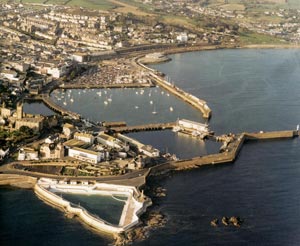
On the 29th October 1764 the Corporation resolved to build a new quay. The work was completed in 1785 for a total of £3950. In 1809 it was resolved to extend the pier by 150ft, “to encourage and increase trade in the town”. Work took place between 1811and 1813 at a total cost of £6500.
In 1817 the Corporation placed a small lighthouse on the end of the quay to replace the lantern washed away by a great storm in January of that year. The lighthouse was to show mariners when they were in 10 feet of water, and to guide them round the pier head. This was replaced once more in 1825 when it was destroyed once again by a storm.
In 1840 the Corporation secured an Act of Parliament stating, “Trade and shipping having greatly increased, it would be of good utility if a wet dock and basin…were constructed and additional quays erected”. This was made possible when the proposal to build a railway to Penzance was announced. In April 1848 the pier had been completed to a length of 1200 feet it was called the Albert Pier after the Prince Consort, who landed there in September 1846. The Queen stayed on the Royal Yacht in Mount’s Bay.
In December 1848 a number of ships sustained damage entering the harbour to escape a threatening storm. The best that could be done was to raise money locally and extend the South Pier by 200-300 feet. The extension was started in December 1852 and after its completion a new lighthouse (still in position) was erected at its seaward end and went into service in August 1855.
In 1878 the decision to proceed with the floating dock was taken it was completed in November 1884, and is now proud to home the Bag O’ Rags!
A Brief Time line of Penzance
1014 Mount’s Bay inundated by a “mickle seaflood” Tidal wave when many towns and people were drowned.
1099 The Bay again inundated by the Sea.
1313 First quay
1322 Records show eight fishing boats each paying 2 shillings per annum to the Duchy of Cornwall.
1425 Penzance boats began carrying pilgrims to the shrine of St James of Compostella in North Spain.
1512 Mar. 16. Charter from Henry VIII. granting profits from all ships visiting the harbour.
1514 Marazion burnt by the French.
1537 August. Naval Engagement in Mount’s Bay between the French and English.
1578 Town visited by plague.
1595 July. Spaniards landed at Mousehole, and burnt part of Penzance.
1630 Penzance Quay Dues let for £21 (earliest recorded date).
1634 Turkish Pirates infest the coast. [“Turk” was a description of any raider of Moorish or North African origin]
1642 The Mount seized by Charles I.
1646 & 1648 Town sacked by the Parliamentary soldiers.
1647 Town again visited by plague.
1656 Penzance Quay dues let for £25 per annum.
1740 Battery built on rocks near the Old Quay, protection from invaders from the sea.
1760 Pirates visited Penzance.
1766 Old Pier built. Extended in 1785, in 1812 and in 1853
1779 The Mount Batteries fire on Pirate Ship. The last Engagement in the Bay.
1795 First Lighthouse on the Longships erected.
1815 Oct. 19. Capstone (weighing 3 tons) of Lanyon Quoit, Madron, blown off in a gale of wind. Replaced in 1824.
1817 Jan. 20. Great Storm and extraordinary High Tide. Much damage (£5,000) done to the Quay, Shipping, Boats, Houses etc.
1825 The first steamer came into Penzance Harbour. First Lifeboat stationed at Penzance. Since then seven other Lifeboats have been placed here, and 167 lives saved. Closed 1917.
1851 Mary Kelynack, an old Newlyn fishwife, walked from Penzance to London with her fish cowl on her back to see Queen Victoria who accepted ½-lb. Of Tea from her as a present from Penzance.
1854 Nov. 18. Newlyn Fishing-Boat, “Mystery,” sailed to Australia.
1860 By 1860 over 692 shipwrecks were recorded off the south west's dangerous coastline
1861–69 Lighthouse prepared at the Trinity Yard, Old Quay, for erection on the Wolf Rock. First lighted in December 1869.
1869 Predicted tidal wave at Penzance, flowed as high as top of Promenade wall on a calm day.
1878 The Castle at St. Michael’s Mount renovated and enlarged.
1880 Oct. 7. Road between Penzance and Newlyn washed away by sea.
1883 New Lighthouse erected on the Longships.
1884 Aug. Nov. 11. Floating Dock opened.
1894 July & 1896 July. The Prince of Wales’ Yacht, “Britannia,” raced in Mount’s Bay Regatta and won the first.
Nov. 11. Great Flood in West Cornwall. 2.33 inches of rain fell at Penzance in 24 hours 52,778 gallons per acre.
1906 Jan 25. Dense Fogs infested the coast of West Cornwall continuously from May to August. (Unprecedented).
July 18–24. Large Fleet of nearly 200 British Warships assembled in Mount’s Bay for a review which did not take place.
Sept. 21. Great successful swim by Mr. Richard Hicks (of Penzance) from Newlyn Pier to St. Michael’s Mount in 2 hours and 5 minutes.
Dec 26 to 28. Heavy fall of snow.
1911 Lifeboat House and Slip built at Penlee point.opened Oct 25, 1913 Home of the Solomone Browne that went down with all hands lost in 1982.
July 1 About 60 Whales became stranded on the Eastern Beach, near Ponsandane.
July 8 Maximum Temperature 83.7 degrees [Fahrenheit]. Highest recorded since Meteorological Station was intituted.
1912 Aug. A large number of Sharks visited the Bay.
1915 April 29. Newlyn Pier extension (100 feet), including tidal observatory, of which there are only two in the Kingdom,
Nov. 12. Terific gale caused much damage to property and uprooted large trees.
1916 Oct. Ancient Bronze cannon believed to be from the Armada, found at Low Lee, presented to the town.
Nov. Continuous heavy S.E. gales, doing considerable damage along the sea front.
1917 Jan. 16 to Feb. 12. The most severe spell of frosty weather experienced since 1895. Frost recorded on 13 days during this period. Min. temp.25.2F.
1920 Feb. 2. Butter 5/– [5 shillings] lb.
Feb. 7. Demonstration by a thousand St. Just and Pendeen miners and clay workers, who marched to Penzance as a protest against the price of butter. Overturn cans of milk into the harbour.
1921 June 1st to July 14th. Six weeks drought,
1929 Swimming Matches held in the harbour. Driest Summer recorded for 120 years.!